
Halfway to 5 years
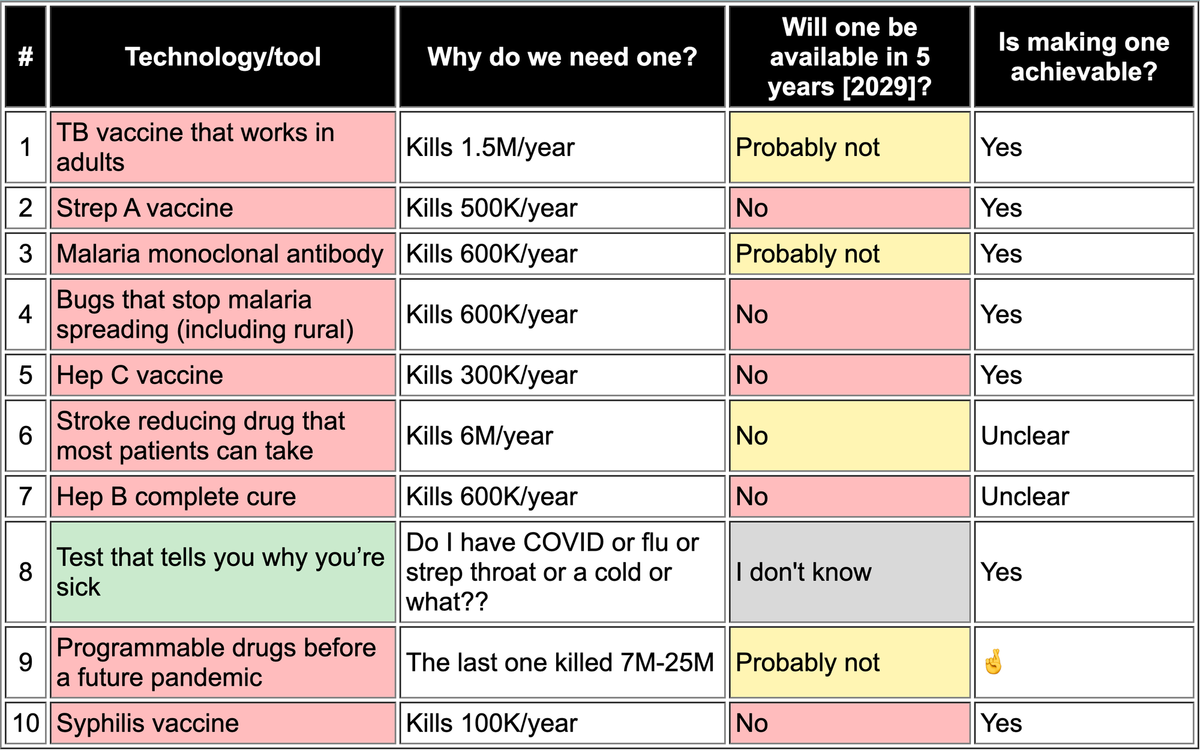
I started this blog in February 2024, with a post about February 2029. Reviewing at the halfway point: nine of the ten technologies I wrote about are still unavailable, and we're not close on most of them.
Taking the first three rows only: since February 2024, more than three million people died from tuberculosis; a million people died from rheumatic heart disease and of strep A, sometimes under the added stress of pregnancy; and more than a million children died from malaria.
My purpose in stating those horrible facts is not to spike anxiety nor to point blame. It is not possible to solve these problems suddenly, so anxiety doesn't help much; and it is not possible to solve them alone, so no individual is to blame. To reach a happier ending, each story must involve hundreds of scientists and thousands of participants in research.
The cells are red and yellow because I still do not believe they are likely to be achieved by February 2029. However, I feel quite differently today to how I felt in February 2024. Today, I feel a quiet optimism bubbling within me that the red cells cannot contain.
I now view each row as a choice of what we want the 2030s to look like. I believe all rows are possible in that time frame, and none are inevitable.
The tools now available, including mid-2026 AI systems, paired with the right scientific teams and appropriate funding, may well be enough. It is time.
If you are considering where to point the next phase of your career, and looking for a nudge from a stranger on the internet, I encourage you to take the plunge: join (or start) one of the companies, agencies, or nonprofits involved in moving from red to green on diseases like these.
For those of you working hard on one of these problems already: in case we never meet, I thank you, and wave from my corner of the internet to yours. 👋❤️